
Why benchmarks feel like truth but aren’t
A number on a leaderboard is seductive. It compresses months of research, engineering, and inference into a single float. It invites comparison. It lets you say “Model A outperforms Model B” without reading a paper, without running a test, without knowing what the test actually measured.
That seduction is the problem. Benchmarks are not product acceptance tests. They are narrow, static snapshots of performance on curated tasks under controlled conditions. Production is none of those things.
What benchmarks actually measure (and miss)

Take a speech-to-text model scoring low word error rate on LibriSpeech. That number looks like a pass. But LibriSpeech is read speech from audiobooks—clean audio, standard American English, predictable vocabulary. Put that same model on call-center transcripts with domain-specific jargon, code-switching, or regional accents and the error rate climbs fast.
Benchmarks measure what their creators chose to measure. The HELM project by Stanford CRFM makes this explicit by evaluating models across multiple scenarios—but even a multi-scenario benchmark is bounded by the scenarios its designers imagined. MLCommons Inference benchmarks focus on throughput and latency under standardized conditions, not on whether the model produces safe or useful outputs in your specific context.
What benchmarks systematically miss:
- Edge cases in your domain. A coding benchmark tests general programming ability, not your internal API conventions or legacy code patterns.
- Failure modes that matter to your users. A benchmark might test factual accuracy but not whether the model confidently asserts false information about your product.
- Interaction effects. Benchmarks test isolated tasks. Production systems chain calls, pass context between components, and degrade in ways no single benchmark captures.
The gap between leaderboard rank and production reliability
A model that tops every public leaderboard can still fail catastrophically in production. The reasons are structural:
Distribution shift. Benchmark test sets are static. Production data drifts. A model optimized for 2023 benchmark data may collapse on 2024 user inputs.
Metric mismatch. Benchmarks report aggregate scores. Production systems need per-instance reliability. A model that averages high accuracy may fail on the small fraction of inputs that constitute your most critical use cases.
Safety and robustness are not benchmarked. Red-teaming, adversarial inputs, and safety evaluations require purpose-built test suites that no general benchmark provides. A model can score well on standard tests while being trivially jailbroken.
Building product-specific evals
The alternative is not to abandon benchmarks. Treat them as one input among many. A product-specific evaluation stack should include:
-
Task-specific test data. Collect or generate examples that reflect actual production inputs—real user queries, domain terminology, edge cases from logs.
-
Failure thresholds defined in advance. Decide what constitutes a pass or fail before running tests. A small drop in accuracy might be acceptable; a tiny increase in hallucination rate might not be.
-
Red-teaming suites. Systematically probe for failure modes: adversarial prompts, out-of-distribution inputs, boundary conditions. This is not a one-time exercise; automate it and run on every candidate model.
-
Human evaluation for subjective quality. Benchmarks cannot measure tone, safety, or appropriateness in context. Human raters using clear rubrics catch what automated metrics miss.
When benchmarks are useful (and when they mislead)
Benchmarks serve as filters, not validators. Use them to narrow the candidate pool. If a model scores below a threshold on relevant benchmarks, it is unlikely to perform in production. But passing the benchmark is not sufficient—it only means the model has not been eliminated yet.
Benchmarks mislead when they are treated as acceptance criteria. A vendor showing a leaderboard rank is not providing evidence that their model works for your use case. They are providing evidence that their model works for someone else’s test.
A practical workflow
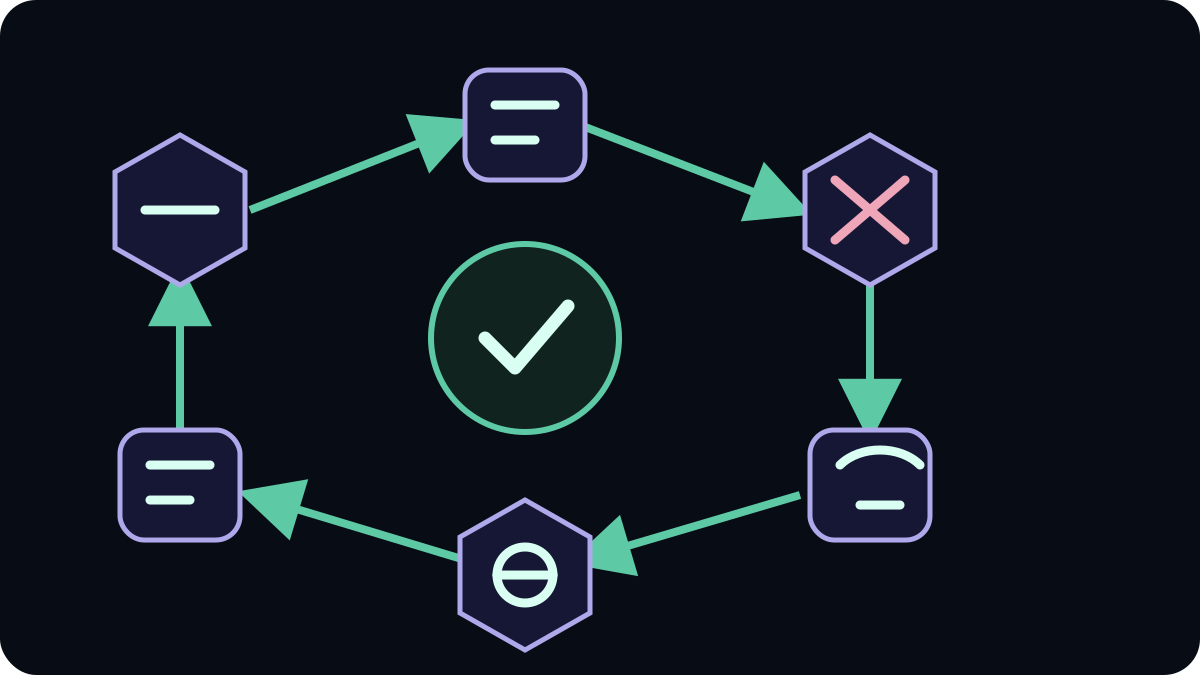
- Screen with benchmarks. Use public benchmarks to eliminate models that clearly underperform on relevant dimensions.
- Build domain-specific test sets. Curate examples from production logs, domain experts, and synthetic generation.
- Define thresholds per failure mode. Know what you will accept and what you will reject before testing.
- Run red-teaming and adversarial evaluation. Automated and manual probes for safety, robustness, and edge cases.
- Human evaluation for subjective criteria. Tone, helpfulness, safety, appropriateness.
- Document what the tests did not measure. Every evaluation has blind spots. Make them explicit.
The benchmark is a starting point, not a conclusion. The product acceptance test is what you build after you understand your own failure modes.